
Skyray instrument applications
Select instruments by industry, sample and required analytical information — with the requirements of the Polish and European market in mind.
As the Polish representative of Skyray Instrument, we match instruments to the specific application — from RoHS and REACH compliance, through metal and coating analysis, to environmental monitoring. Below are the most common industries and methods; for each we point to the techniques and example instruments worth considering.
Packaging — PPWR and 94/62/EC
XRF screening of lead, cadmium, mercury and chromium in packaging and packaging components.
RoHS and restricted substances
Control of materials and components (XRF) and phthalate screening by pyrolysis GC.
Coating thickness
XRF analysis of electroplated coatings and functional layers.
Precious metals
Gold, silver and jewelry-alloy analysis by XRF and spark OES.
Metals and alloys
Material identification and alloy composition control in the lab (OES, WDX) or field (XRF, LIBS).
Trace and ultra-trace analysis
Element determination at ppm–ppt levels by ICP-OES, ICP-MS and AAS.
Organic compounds and residues
Identification and determination of compounds and residues by GC, GC-MS and LC-MS.
Petrochemicals and sulfur
Fuel, oil and petrochemical sample analysis (XRF, WDX, ICP-OES).
Environment and food
Heavy metals, contamination and food-safety workflows (XRF, ICP, AAS, GC-MS).
Applications by industry
Heavy metals in packaging — PPWR and 94/62/EC
RoHS applies to electrical and electronic equipment, not packaging. Since 12 August 2026, packaging requirements have been set directly by Regulation (EU) 2025/40 (PPWR), which replaced Packaging Directive 94/62/EC. PPWR retains the limit: the sum of lead (Pb), cadmium (Cd), mercury (Hg) and hexavalent chromium (Cr(VI)) in packaging or a packaging component must not exceed 100 mg/kg.
XRF provides fast, non-destructive screening of Pb, Cd, Hg and total chromium in plastics, paper, board, glass, metals, coatings and printing inks. A total-chromium result is a conservative screen: XRF does not distinguish Cr(VI) from Cr(III), so a borderline result or exceedance requires confirmation with a Cr(VI)-selective method. The instrument supports incoming-goods and production control, but a screening result is not by itself a certificate of compliance.
PPWR also sets separate PFAS limits for food-contact packaging. XRF does not identify individual PFAS and does not replace the required targeted analyses. Total-fluorine measurement can only serve as a preliminary screening step.
Instrument selection: EXPLORER 3000 for incoming inspection and large items without sampling; EDX 1800E for routine laboratory QC; EDX3600H for varied matrices and sample forms; EDX6000C for batch measurement and automation.
XRF analyzers for packaging control

xrf
EXPLORER 3000
Handheld (portable) XRF harmful-element analyzer — designed for RoHS, for testing electronics, toys, packaging, batteries and large parts without taking a sample.
- Handheld and lightweight — performance close to benchtop instruments
- Digital multichannel technology — lower detection limits and high stability
- Tests large parts directly on the surface, without cutting
- Applications: RoHS, toys, packaging materials, batteries
xrf
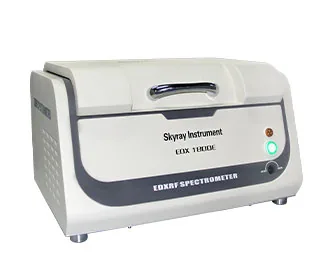
EDX 1800E
Benchtop XRF spectrometer (down-looking) with a FAST-SDD detector — detects up to 75 elements down to 1 ppm, for RoHS, alloy, coating and precious-metal analysis.
- FAST-SDD detector; detects up to 75 elements down to 1 ppm
- Repeatability and stability at the 0.05% level
- Down-looking design, up to 50 W tube, motorized collimators and filters
- Safety: lid-closure self-check and an emergency high-voltage lock
xrf
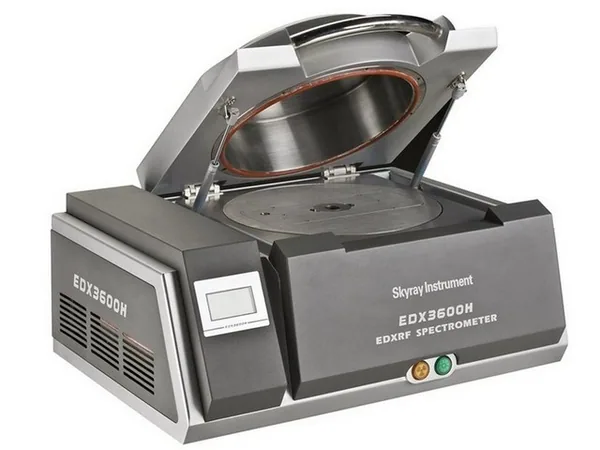
EDX3600H
Professional benchtop EDXRF spectrometer for full elemental analysis (sodium to uranium) with an SDD detector — for alloys, precious metals, coatings, catalysts, geology and RoHS.
- SDD detector with 135–145 eV resolution
- Measuring range from 1 ppm to 99.99%; elements from Na to U
- Light-element optimization; air or optional vacuum atmosphere
- Built-in CCD camera with an automatic filter and collimator changer
xrf
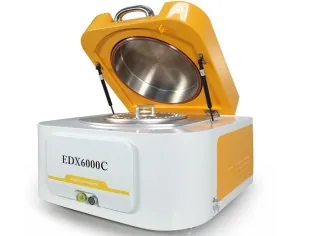
EDX6000C
New-generation energy-dispersive XRF (EDXRF) spectrometer with a graphene-window SDD detector — elemental analysis down to fluorine, single- and multi-cup modes, and automated RoHS software.
- Electrically cooled SDD detector with a large-area, ultra-thin graphene window
- Element range extended down to fluorine (F); detection limit to 0.2 ppm in light matrices
- Count rate up to 300 KCPS with 4096-channel processing
- PLC multi-cup chamber (9 / 12 / 20 positions) with auto-rotation for unattended batches
RoHS, REACH and electronics
Manufacturers and importers of electrical and electronic products for the European Union must demonstrate compliance with the RoHS Directive and the REACH Regulation. Energy-dispersive XRF spectrometers enable fast screening of restricted metals (Pb, Cd, Hg, Cr, Br) directly on components, while phthalates are determined by pyrolysis in gas chromatography. This underpins incoming-material inspection and production control in electronics.
Coating thickness and electroplating
In electroplating, electronics and connector manufacturing, measuring coating thickness and composition is critical. XRF analyzers measure multi-layer coatings non-destructively — from large PCB boards, through micro-areas of IC pins, to complex-shaped parts. For the full sample-preparation workflow we also offer XRF accessories: pellet presses and mills.
Precious metals and jewelry
Buying, refining and trading precious metals require fast, accurate assaying. Handheld and benchtop XRF analyzers determine gold, silver, platinum and palladium content in seconds without damaging the item, while spark OES spectrometers provide precise control of trace elements in high-purity gold.
Petrochemicals, fuels and sulfur
Sulfur limits in marine fuels (the MARPOL convention) and road fuels require routine control. Portable XRF analyzers determine sulfur in fuel in the field, while wavelength-dispersive WDX and ICP-OES spectrometers control chlorine, silicon, phosphorus, and wear elements and additives in crude oil and oils.
Metals, alloys and scrap recycling
Alloy grade identification (PMI) and scrap sorting are everyday tasks in steel mills, foundries and scrap yards. Handheld XRF and LIBS analyzers identify material in seconds in the field, while laboratory spark OES and WDX spectrometers provide full composition control, including carbon and sulfur analysis.
Geology, mining and raw materials
Exploring and controlling the quality of mineral raw materials relies on fast elemental analysis. Field XRF analyzers support exploration, while laboratory WDX and ICP-OES and ICP-MS spectrometers determine contents from major constituents to trace elements in ores, concentrates and construction materials.
Environment, water and food
Controlling heavy metals in soil, water and food requires low detection limits. ICP-MS, ICP-OES and AAS techniques and atomic fluorescence (AFS) determine mercury, arsenic, lead and cadmium at trace levels, while environmental and process analyzers — including portable water testers and VOC analyzers — support field and process monitoring.
Batteries and new energy
The growth of e-mobility and the EU Battery Regulation set new requirements for controlling raw and active materials. ICP-OES and ICP-MS and XRF spectrometers determine lithium, nickel, cobalt, manganese and metallic impurities in precursors, cathodes and electrolytes, supporting cell quality and safety.