
XRF gold analyzers and precious metal analysis
Choose an XRF spectrometer for non-destructive checks of jewelry, precious metal alloys and bullion.
Gold buying, jewelry production and refining have different analytical requirements. An XRF gold analyzer helps check the composition of the measured area without destroying the item. The result must be assessed against the surface condition, material uniformity and calibration. Testing finished jewelry does not necessarily establish the composition of the entire item.
Instrument selection starts from the metals to determine, the required result tolerance, the size of the measured details and the daily throughput. These determine the analytical program, collimator and configuration.
How to choose an XRF gold analyzer
- Jewelry, coins and precious metal alloys: the EDX 3000PLUS determines gold, silver, platinum and palladium as well as common alloying elements (Cu, Zn, Ni). Its 25 mm² FAST-SDD detector with resolution down to 125 eV helps separate neighbouring lines, such as iridium and gold in platinum.
- Small details and joined parts: collimators down to 0.2 mm and a camera let you target the measured area — a clasp, solder joint or single link — instead of averaging the whole item.
- Several tasks at one inspection point: compare the required elements, result tolerance, sample geometry and throughput. The term “gold analyzer” alone does not define the right configuration.
Plating, solder and non-uniform items
XRF examines material near the surface. Gold plating, protective layers, solder or contamination can make the result unrepresentative of the interior. Measurements at several points help reveal differences, but do not automatically guarantee detection of every filled or counterfeit item. Uncertain cases need an appropriate confirmatory procedure.
Reference-material checks and repeatability assessment on actual samples help establish whether the method meets the needs of a buying operation or laboratory.
XRF analyzer for precious metals
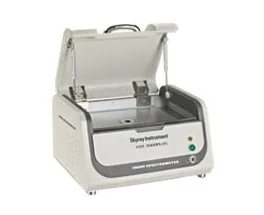
xrf
EDX 3000PLUS
Energy-dispersive XRF spectrometer for precise precious-metal analysis (Au, Ag, Pt, Pd) — a large-area 25 mm² FAST-SDD detector and resolution down to 125 eV.
- Large-area 25 mm² FAST-SDD detector with resolution down to 125 eV
- Count rate up to 80,000 — 5–10× more than a 6 mm² Si-PIN detector
- Accurate analysis of Au, Ag, Pt, Pd, Cu, Zn, Ni in jewelry
- Compliant with the GB/T 18043-2000 standard
What determines instrument selection and quotation?
Describe the items, metals of interest, coatings or solder, required accuracy and daily throughput. State whether the task is jewelry buying, production QC or refining. These requirements determine the model, analytical programs and accessories; you do not need to choose an instrument first.
Questions about selection and measurement
Can XRF prove that an entire item is solid gold?
It measures the tested area near the surface. Coatings, filled items and non-uniform materials may require additional procedures. A single XRF result is not unconditional proof of an entire item’s composition.
Does testing damage jewelry?
XRF measurement itself is non-destructive and needs no sample preparation. Only confirmatory methods used in uncertain cases, such as cutting or fire assay, may leave a mark.
What information is needed for an analyzer quotation?
Provide the sample types, metals, result requirements, throughput and any coatings or solder. This information supports model and configuration selection.