
Ore and mineral analysis — XRF, WDX and ICP-MS
Choose methods for ores, concentrates, drill cores and construction materials: field screening, composition control or trace analysis.
Geological analysis ranges from rapid field assessment of material variability to laboratory determination of ore or concentrate composition. Each task needs representative sampling, suitable calibration and the sensitivity required for the target elements.
Handheld XRF can support sample selection and deposit mapping. A result from a small measurement area should not automatically be treated as the composition of an entire rock, core or batch of material.
How to choose an ore or mineral analyzer
- Field screening and exploration: EXPLORER 7000, a handheld XRF analyzer for ore and geological samples, with GPS to associate results with measurement locations.
- Laboratory composition control: WDX-400, a multichannel WDXRF with 10 fixed channels for routine composition control of mineral raw materials (Na, Mg, Al, Si, S, Cl, K, Ca, Fe and P or Ti as standard) in powders, pellets and fused beads. The channel set and analytical program are selected for the matrix.
- Trace analysis in a suitably prepared solution: ICP-MS2000. Digestion must be selected for the minerals and required determinations.
Moisture, particle size and sample preparation
Moisture, grain size and non-uniformity can change an XRF result. Field measurements on an exposed surface and laboratory measurements of dried, ground samples are not necessarily comparable without a defined procedure.
For powders, consider grinding and pressed-pellet preparation where appropriate. Reference materials of known composition and comparative testing help establish configuration suitability for the project.
Analyzers for field and laboratory work
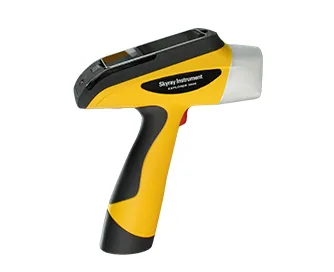
xrf
EXPLORER 7000
Handheld XRF analyzer for ores and geological samples — with digital multichannel processing, built-in GPS and an HD camera for fast on-site elemental assessment.
- Handheld, lightweight, water- and dust-proof for harsh field use
- Digital multichannel processor — low detection limits, benchtop-class performance
- Built-in GPS — records coordinates, maps deposits and defines boundaries
- 270° rotatable 5-inch HD touchscreen and Bluetooth printing
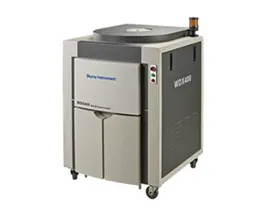
wdx
WDX-400
Multi-channel wavelength-dispersive (WDXRF) spectrometer with 10 fixed channels — simultaneous analysis of 10 elements from Na to U, with liquid-sample analysis once fitted with helium purging.
- 10 fixed channels — simultaneous analysis of 10 elements from Na to U
- Standard configuration: Na, Mg, Al, Si, S, Cl, K, Ca, Fe and P or Ti
- Fast, non-destructive analysis of powders, pressed pellets, glass beads and bulk
- Digital MCA with real-time detection
Information to include in your inquiry
Describe the ore or raw material, elements and concentration ranges, sample form, field conditions and throughput. State whether the task is screening, production control or laboratory confirmation, and what sample preparation is available.
Questions about selection and measurement
Does a rock-surface result describe all of the material?
Not necessarily. Grain size, minerals and non-uniformity can produce differences. Sampling and preparation must match the analytical objective.
Does handheld XRF replace a laboratory?
It can support exploration and sample selection. Whether it is sufficient for a decision depends on the required data quality. Confirmation or trace determinations may need laboratory methods.